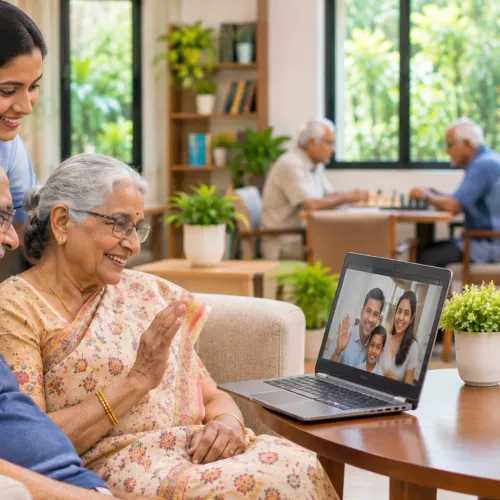



Moving into retirement housing together raises practical questions beyond whether a residence has space for two people. You need to confirm the accommodation, calculate the full cost, understand what happens when care needs differ, and compare the move with staying at home or living with family.
Key takeaways
- Get written confirmation that both partners can share one unit.
- Ask how care changes affect room assignments and monthly fees.
- Add two deposits, care charges, meals, transport and future increases.
- Choose services that support daily life without removing private time.
Can a couple move in together and remain in the same unit?
Joint admission does not guarantee that spouses will remain together. Before signing, ask the residence to confirm in writing that both names are admitted, whether they may occupy the same room or unit, and what happens if one partner later needs more care.
1. Compare the available formats: private senior living rooms, shared senior living units, or a private unit for couple accommodation. Confirm whether each option has an attached bathroom, kitchen or kitchenette access, cupboard and luggage storage, supplied furniture, and enough clear floor space for walkers or wheelchairs.
2. Test the complete route from the unit to dining areas, toilets, gardens and emergency exits. Check for step-free or ramped access, firm handrails, non-slip flooring, wheelchair-compatible door widths and turning space at doors, bathrooms and corridors. A lift alone does not make retirement living for couples accessible.
3. Ask whether you may bring beds, chairs, appliances, religious items, photographs and other personal belongings. Confirm electrical safety rules, storage limits and who pays if furniture must be removed or adapted.
4. Get the temporary-illness policy in writing. Ask whether a spouse may stay during recovery, who provides help, when hospital transfer is required, how ambulance transport works and whether the partner can return after hospitalisation.
5. Separate independent living from nursing care. Independent accommodation does not promise 24-hour nursing, medication administration or emergency treatment.
Under the Maintenance and Welfare of Parents and Senior Citizens Act, 2007, a senior citizen is an Indian citizen aged 60 or above. That definition creates no automatic right to private retirement-community accommodation or nursing care; the admission contract controls those services.
What happens when one partner needs more help than the other?
Admission together does not guarantee that a couple will stay together. Ask for written terms covering different care needs in a couple, including whether one partner can move to a higher care level on the same site while the other remains in the original unit.
- Does the residence offer independent living, assisted living for couples and nursing care on one campus? Can a spouse remain in the same unit if the other needs more support, or must either partner transfer?
- What happens if one resident is discharged or transferred? Ask about notice, alternative accommodation, fees, belongings, readmission and whether the couple can reunite after hospitalisation.
- Require definitions of medication management: storage, reminders, administration, insulin support and controlled-drug management. “Medical assistance” is not specific enough.
- Obtain written policies for bathing, toileting, transfers, two-person lifting, wheelchairs, walkers and incontinence. Confirm which tasks staff perform and which trigger extra fees.
- Ask how the residence handles dementia care in senior residences, wandering, secure exits, behavioural changes and night observation. Dementia care requires a separate assessment; ordinary assisted living is not automatically safe for cognitive impairment.
- Get the hospitalisation and return policy, ambulance arrangement, nearest hospital, escort responsibility, emergency transport costs and the person who responds to a fall or acute illness at 2 a.m.
- Request a shift-wise staffing plan naming overnight nurses, trained caregivers and relief staff. There is no universal private-residence staffing ratio, so inspect the actual overnight coverage.
How should you calculate the full cost for two residents?
Build a 12-month worksheet for senior living costs for couples, then compare the total with two separate resident bills. Record every charge in writing:
Item | Couple package | Two separate charges Entry deposit or purchase price | | Monthly maintenance and utilities | | Meals for both residents | | Special diets | | Housekeeping: room, laundry, linen | | Care-level surcharges | | Medical support | | Transport or escort charges | | Activities and guest stays | | Repairs and annual increases | |
Ask whether couple package fees include meals for both people, whether special diets cost extra, and whether housekeeping covers the room, laundry and linen separately.
A refundable retirement residence deposit returns under the stated conditions. A transferable interest passes to an approved buyer or successor, while a forfeitable entry amount is retained partly or fully under the contract.
The senior housing contract must show the exact exit deduction formula, notice period, renewal terms, and treatment of the deposit after one spouse dies, leaves, or moves to hospital care.
For a purchased unit, verify title, association rules, resale restrictions, and service obligations separately. For a lease or licence, check tenure, termination, renewal, deposit protection, and the operator’s obligations if services stop.
Section 19 of the Maintenance and Welfare of Parents and Senior Citizens Act, 2007 concerns state-supported homes for indigent senior citizens. It does not create universal entitlement to private accommodation or payment of private bills.
Which daily services protect independence without erasing privacy?
A visit should test senior residence daily services at the hours you would actually use them, not just inspect the room. Ask for meal timings, dining-room seating, laundry collection, housekeeping frequency, maintenance response times, appointment transport, recreation, community activities and the emergency-call procedure.
| Service | Ask to test | Failure to notice |
|---|---|---|
| Meals and privacy | Can each partner follow a different sleep schedule, cook, dine privately, receive visitors, practise religion and spend time outdoors? | Fixed routines can erase privacy for couples in senior living. |
| Daily access | Can you leave independently, use internet and a phone, park, and summon help? | Dependence grows when basic access is controlled. |
| Guests and animals | Check visitor and pet policies, visitor hours, overnight guest rules and charges. | Flexible assumptions become disputes. |
Also ask who contacts family, arranges transport and supports the remaining partner when the other is away for treatment.
- Request fire approvals, evacuation plans, drill records, alarm and sprinkler maintenance logs, generator capacity, and a plan for residents unable to use stairs or lifts. This is fire safety senior housing Pune, not merely lift access.
- In Pune, inspect drainage, seepage, backup water and power, lift reliability, ambulance access during monsoon disruption and staff accommodation for essential personnel.
- Confirm the nearest hospital, ambulance provider, escort responsibility, emergency transport payer and return-after-hospitalisation policy.
- Ask what happens if one partner needs higher care: same-unit residence, on-site transfer, discharge terms and night response to a fall or acute illness.
Is moving into senior housing together better than the main alternatives?
A couple’s best choice depends on health, money, daily habits and where family can realistically help. Senior housing versus staying at home is not simply a choice between comfort and independence.
| Option | Privacy and routine | Maintenance, care and emergencies | Cost and changing needs |
|---|---|---|---|
| Moving together into a senior residence | Private space with planned social contact and shared activities | Less household work; verify caregiver reliability, transport and 24-hour escalation | Predictable only if the contract lists every fee; one partner may later need higher care |
| Staying home with hired caregivers | Maximum privacy and familiar routines | You manage repairs, staffing gaps, leave cover and emergency response | Caregiver and hospital costs can rise quickly; care levels can differ at home |
| Downsizing for retirement | Smaller, accessible home with control over visitors and schedules | Fewer repairs, but you still arrange care, transport and urgent help | Lower maintenance can be offset by rent, adaptation and private care |
| Living with children or relatives | More family contact, less privacy and possible routine conflicts | Support depends on distance, work and health; another city, province or country limits response time | Family support is not automatic responsibility for every private residence bill |
The Maintenance and Welfare of Parents and Senior Citizens Act, 2007 provides a maintenance-claim mechanism against children or relatives in defined circumstances. It does not replace the facility contract or make children liable for every private residence charge.
For a Pune shortlist, including Vrindavan Old Age Home Pune in Ambegaon Budruk or Ambegaon Pathar, demand written answers about:
- Same-unit residence after one partner’s care level changes
- Care escalation, hospital return, ambulance escort and emergency charges
- Total cost, annual increases, deposit deductions and exit rights
- Staff overnight, monsoon access, backup power and lift reliability
Choose documented commitments, not a brochure’s promise of comfort.
Related services
Senior Citizens Looking for a Change in Lifestyle Senior Citizens Looking for a Change in Lifestyle Elderly individuals who prefer a community environment instead of living alone at home. View service → |
Independent Living for Seniors Whose Children Live Abroad Vrindavan Oldage Home – Your Second Home Independent Living for Seniors Whose Children Live Abroad Vrindavan Oldage Home – Your Second Home When your children live abroad, you can still enjoy a safe, comfortable, and fulfilling life with the care and companionship you deserve. View service → |
Frequently asked questions
Can a couple move into senior housing together and remain in the same unit?
Ask the residence to confirm in writing that both partners are admitted, whether they can share one room or unit, and what happens if one later needs more care.
What happens when one partner needs more help than the other?
Ask whether the residence can provide different care levels, how staff assess changing needs, whether partners can remain nearby, and when a transfer becomes necessary.
How should couples calculate the full cost of senior housing for two residents?
Add two admission or security deposits, the shared-unit fee, care charges for each person, meals, medication support, transport, utilities, laundry, and future fee increases.
Which daily services protect independence without removing privacy?
Look for optional meals, housekeeping, laundry, transport, emergency response, wellness activities and scheduled check-ins, while confirming which services are private and which are shared.
Is moving into senior housing together better than the main alternatives?
Compare senior housing with staying at home, hiring home-care workers, living with family and separate care settings by weighing safety, privacy, cost, social connection and future care needs.
Related service
Independent Living Centre in Pune for Senior Citizens Independent Living Centre in Pune for Senior Citizens Vrindavan Oldage Home – Your Second Home Looking for a safe, comfortable, and caring independent living centre in Pune for senior citizens? Vrindavan... View service → |